
Using BEAD Funds to Help Boost Subscriptions: Doing Good While Doing Well
November 16, 2026
The National Telecommunications and Information Administration (NTIA) will soon publish guidance to state and territorial broadband offices (so-called “Eligible Entities”) on how to spend Broadband Equity, Access, and Deployment (BEAD) funds that remain after funding last-mile broadband deployments in unserved and underserved communities across America, what we refer to as the Digital Opportunity Dividend. One question is whether Eligible Entities should use a portion of such funds to increase home broadband subscriptions. These efforts could include digital skills and digital navigators programs, as well as direct support to lower-income households to make service more affordable (i.e., a more limited version of the highly successful Affordable Connectivity Program (ACP)).
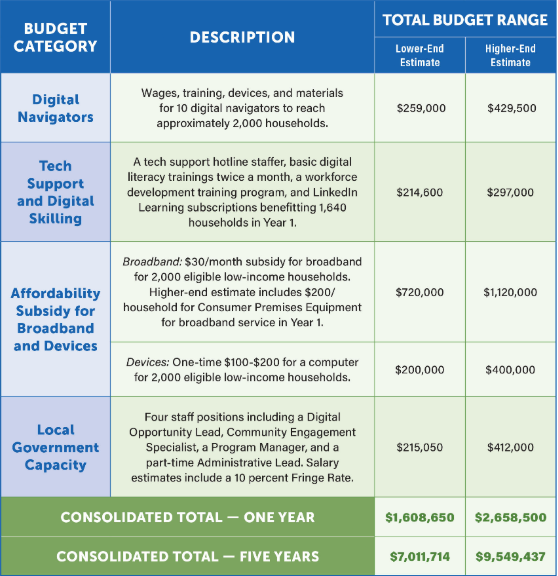
In a previously published report, we noted approximately 21% of American adults do not subscribe to home broadband. Key barriers to subscription include lack of relevance, digital skills or perceived need, affordability, and lack of a device. Our report estimated what it would cost for communities to address each of these barriers. For example, a hypothetical community of 10,000 households seeking to help the 20% facing a broadband adoption barrier(s) could build a program tailored to its specific needs for the costs projected in this chart.
As we outlined in our blog on the economic benefits from using the Digital Opportunity Dividend on broadband adoption, workers with digital skills can earn up to 23-45% more than a job that requires no digital skills. A lack of investment in students’ digital skills is also harmful for our economy, contributing to a national GDP loss of $22 billion to $33 billion annually. Many others have described the economic benefits resulting from investments in broadband affordability programs.
But these investments aren’t just good for communities and their residents. They also are good for the broadband providers serving these communities. Leveraging recent pricing data from USTelecom, we estimate that increasing 100/20 Mbps home broadband subscription rates from current levels to 95% of U.S. households would increase U.S. broadband provider revenues by approximately $10 billion annually or $100 billion over the next decade. That does not account for additional devices and services that could be sold to these households. Such an opportunity to boost revenue can present a strong case for additional investment by providers in the communities they serve.
Consistent with statutory language in the Infrastructure Investment and Jobs Act (IIJA or Infrastructure Act), as well as the underlying purposes of the BEAD program, we continue to argue that remaining funds – a $17.9 billion Digital Opportunity Dividend (i.e., $23.4 billion in BEAD funds after approval of all Final Proposals – Estimated $5.5 billion for NTIA’s true-up round = $17.9 billion) – should be directed toward activities that promote greater broadband adoption because the economic benefits to communities, their residents, and to the viability of the broadband ecosystem as a whole are game-changing.
Revenue from increasing home broadband subscriptions is real money that could be used to generate more high-paying U.S. jobs, increase infrastructure investment, make networks more resilient, and better prepare Americans for the Artificial Intelligence (AI) economy. To learn more about this analysis or any of our other work, please reach out to greg@vernonburggroup.com or paul@vernonburggroup.com.