
How NTIA’s Average Cost Cap Will Force States to Shift More BEAD Funds Away From Fiber Providers
November 3, 2026
When the National Telecommunications and Information Administration (NTIA) first announced its “Benefit of the Bargain” round of the Broadband Equity, Access, and Deployment (BEAD) program, it anchored it in a technology-neutral approach. As NTIA noted at the time “removing the preference for a single technology will bring the full force of the competitive marketplace to bear and allow American taxpayers to obtain the greatest return on their investment.”
In its announcement for the true-up round, NTIA stated it is focused on getting service to broadband serviceable locations (BSL) left over by “other programs, failures in planned deployments, and changes to the FCC’s broadband DATA maps.” To determine the amount of support available to each of the states and territories (“Eligible Entities”), NTIA will take the total number of broadband serviceable locations (BSL) that are identified through a challenge process as remaining unserved or underserved in each Eligible Entities’ jurisdiction and multiply that number by the average cost of deployment per BSL from the Eligible Entities’ approved Final Proposal. Eligible Entities are expected to serve all remaining BSLs within the limits of this funding, unless they demonstrate “extraordinary circumstances.”
Against that backdrop, we have analyzed the likely impact of NTIA’s average cost cap on Eligible Entities’ allocation of funding among fiber, fixed wireless, and satellite broadband providers. Because the average cost of remaining BEAD-eligible BSLs are likely to be higher cost on average than those locations previously funded through the BEAD programs, many states will be forced to shift a greater percentage of funding away from fiber and toward fixed wireless and satellite connections.
The chart below leverages Vernonburg Group’s cost modeling and mapping capabilities to show how this mix of technologies may further shift away from fiber and toward fixed wireless access (FWA) and satellite in each state across the country.
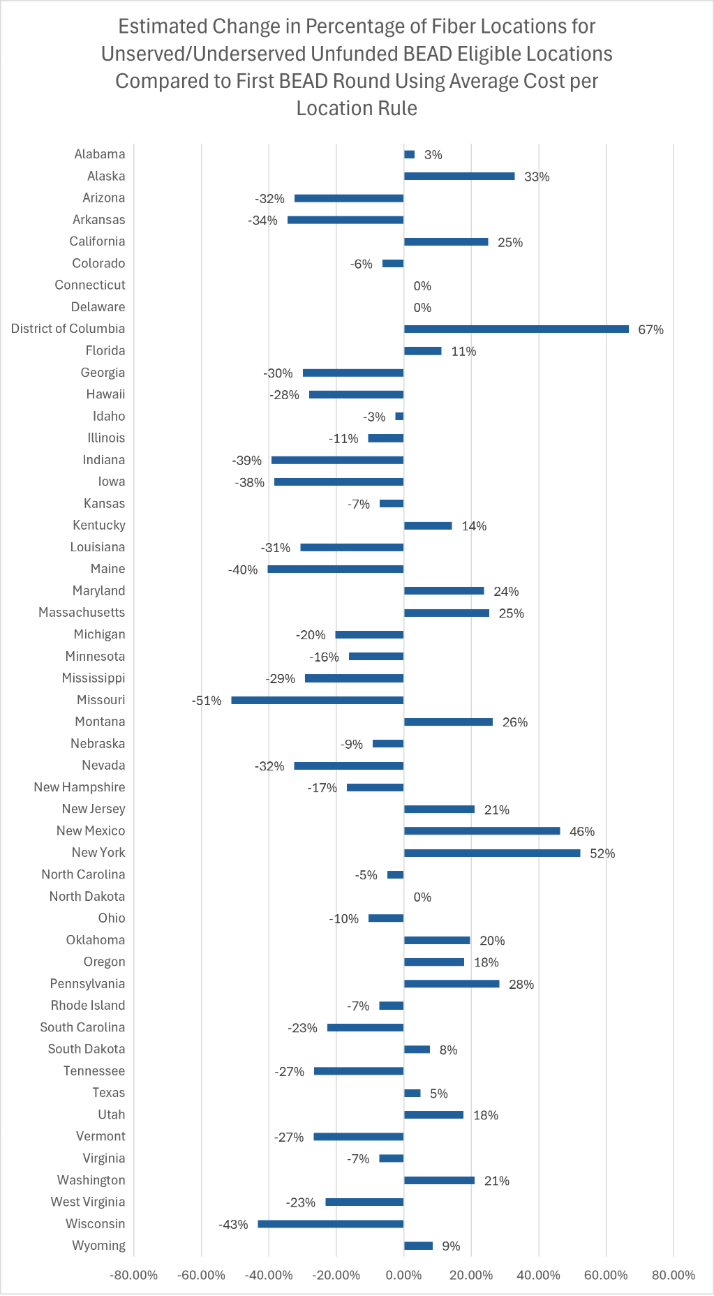
While the shift from fiber and FWA to satellite might not be significant overall, as the chart shows, individual states could see significant declines (and increases, in some cases) in the percentage of funds going to fiber connections in the next round of BEAD funding. We estimate that approximately 28 Eligible Entities will have a reduction in the percentage of fiber deployments, with some like Missouri, Wisconsin, Maine, Indiana, and Arkansas seeing their fiber share decline by approximately 34–51 percentage points. We previously demonstrated, a fiber-only approach was never feasible, even accounting for all available BEAD funding. That said, under the formula NTIA will apply, Eligible Entities can still press for fiber or fixed wireless access (FWA) over satellite when it is economically sustainable, while still selecting satellite technologies where its low deployment costs make it great option for connecting disparate, remote locations that are not suitable for fiber or FWA. Eligible Entities will just need to balance their overall budget to stay below the cap.
If you are a state broadband office and would like to better understand our analysis for your state, please feel free to reach out to us at greg@vernonburggroup.com or paul@vernonburggroup.com.